
Endcaps and origin stories
How I started centering my world around understanding food

I was pushing a cart through the Urbana Meijer in November 2021 when the epiphany struck, when my interest in food, cooking, history, and culture shifted from hobby-level curiosity to something more … serious(?).
It was peak Thanksgiving grocery shopping season, and the endcaps and middle-of-aisle seasonal displays were stacked high with the components for the templated American grand holiday meal. Cans of green beans, Campbell’s cream of mushroom soup, and French’s fried onions. Bags of marshmallows and brown sugar. Sturdy cartons of chicken stock and crinkly bags of seasoned dried bread cubes. Cans of pureed pumpkin and sweetened condensed milk. Cans, cartons, bags, bottles, boxes all arranged with the comforting assurance that all you have to do is buy, open, and combine them in the way described on the back of the package, and you have Thanksgiving.
You can participate in the most important American cultural food tradition without having to do much at all. It was as if that ease was the point.
It made me wonder: What does it mean for my food culture, both broadly as in contemporary American food culture and my own personal food history to be so conveniently package- and assemble-able for purchase, heating, and consumption?
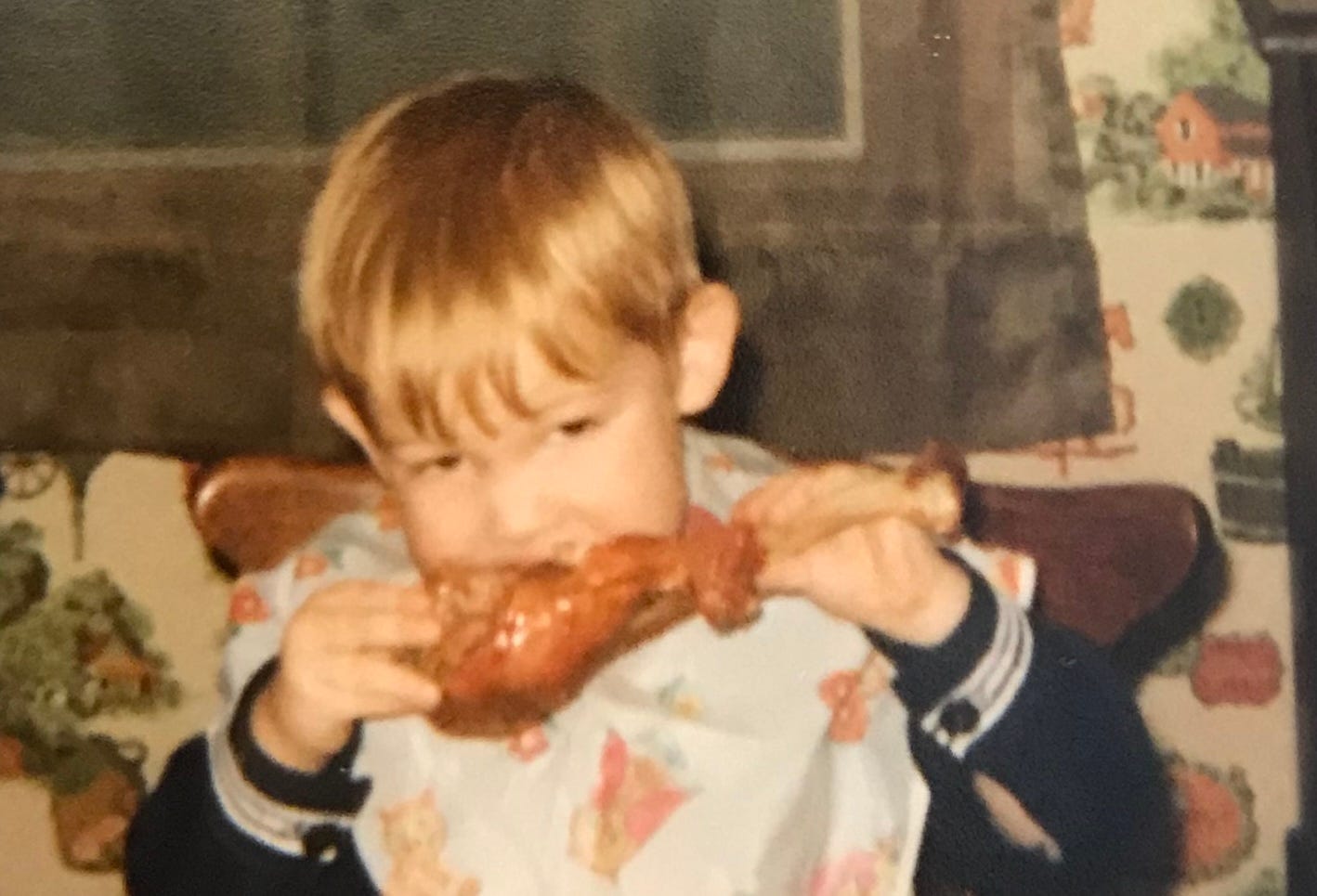
Far from feeling comforted, I didn’t like the vibe this was giving me, and the moment prompted me to think about these two related questions in a more systematic way:
What was my personal food history, and what did it mean that I couldn’t describe it and, more to the point, had never really thought about it? and
What does it mean that America’s greatest shared meal can be reduced to a half-dozen end caps that require little thought, skill, or planning to prepare?
The road to these questions wasn’t purely a revelation, though. There were signs along the way.
Over the several years prior, I’d been moving gradually from being a passive Barefoot Contessa viewer (anyone who doesn’t fold clothes or drift off to a nap without Ina’s help is truly missing out) to someone who occasionally made what she made, as she instructed you to make it. It worked. It was fun. And eventually it started to feel like I was learning to cook and not just following a recipe (don’t get me wrong, I love to follow a recipe, but eventually you also start understanding the patterns that aren’t obvious at first). I started buying her books and realizing I could use what I was learning to compose menus—whole meals that made sense and made people happy.
Buoyed by the confidence that an expert teacher like Ina Garten gives a faithful student, I was soon lured by Jake Cohen’s charm, good looks, and Instagram acumen to start investigating the world of Jewish food. When Cohen’s first cookbook, Jew-ish: Recipes from a Modern Mensch, arrived, I was curious to learn what “Jewish food” meant (beyond the broadly Americanized knowledge I had of bagels and the like). Jake did help us successfully prepare a very beautiful and delicious Rosh Hashanah dinner that first fall after we bought his book: chicken thighs with tzimmes (it would be months before I understood the term), apples-and-honey baked brie, a round challah (although we had it a day late because we made it on the day we had from school, not the night before…whoops!)
But as it turns out, his first cookbook was too complex for my novice status. As a representation of the range of global Jewish food traditions, Jew-ish was beyond my food knowledge that I now know was largely limited to the Ashkenazi tradition. I didn’t have the historical or cultural schema to make sense of the tapestry of foods and recipes from all over the world—which I understand now is a feature of Jewish food.
In the midst of all this, my mom was hospitalized for a condition that led to a lung cancer diagnosis. I was suddenly spending a lot of time alone in my car, driving back and forth to home (rural southern Illinois) and eventually St. Louis where she was transferred once it became clear things were more serious than we thought. I listened to lots of food/culture podcasts like the Bowery Boys’ episode Counter Culture: A History of Automats, Luncheonettes and Diners in New York City and Tablet’s The 100 Most Jewish Foods.
These podcasts lead to books. That fall I read amazing and diverse books about food and the human condition like Michael Pollan’s Cooked, Jane Ziegelman’s 97 Orchard: An Edible History of Five Immigrant Families in One New York Tenement, and Michael Twitty’s Koshersoul: The Faith and Food Journey of an African American Jew. And cookbooks (too many to even start mentioning here) … and eventually 20 semi-structured interviews with very generous friends around my age who were willing to talk about their own food histories and understandings of what food and cooking mean to them.
I did make a conscious choice to focus a good deal of this learning on Jewish foodways and history, partly because if my question is What does it mean to have a food history rooted in tradition and culture and not just consumer ease?, then Jewish food is an awfully rich place to learn. I was also coming to understand that so much of what I connect to and appreciate about my beloved New York City is interconnected with Jewish migration and cultural exchange. At a time in my life that I needed an intellectual project, a place to focus and indulge my curiosity, Jewish food history provided a vital starting point. The fact that this project started as I was pushing a food cart is just a happy coincidence.
My intention for this space, then, is to share some of what I’ve been learning and what I’ve been up to. (There’s going to be a lot of interchangeable I and we here, since most everything I’m talking about has been done with my partner John, but he has his own Substack!) The influence of Jewish food learning and the incredibly warm and inclusive contemporary Jewish food community will be noticeable, but my hope is also broader than that. We live in a world in which food growth, production, and preparation has been purposefully and methodically separated from the fabric of daily life. What happens when we try to re-center it by thinking about it more, handling and working with it more, and sharing it more, in all its forms?
I have a few dozen topics planned so far, and I’ll bring over a (very) few things I wrote on an earlier attempt to get this project started on another platform. I do see the task of writing about my food world in a different way than I did a couple years ago. I know more now, I’ve done more, and though it’s very weird to say this, it’s far easier to write about your food history when you know your mom won’t be reading it.
As Michael Pollan notes, when we talk about our personal food cultures, we usually mean our moms. She’ll figure into this project in lots of different ways, and I like to think that part of what learning about my food history has helped me do is understand her a little better as part of the process.